> For the complete documentation index, see [llms.txt](https://docs.graphite-note.com/graphite-note-documentation/llms.txt). Markdown versions of documentation pages are available by appending `.md` to page URLs; this page is available as [Markdown](https://docs.graphite-note.com/graphite-note-documentation/demo-datasets/what-dataset-do-i-need-for-my-use-case/customer-lifetime-value-prediction-dataset.md).
# Customer Lifetime Value Prediction : Dataset
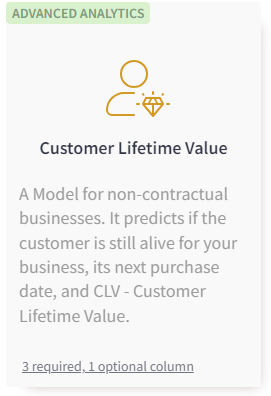
Customer Lifetime Value (CLV) prediction is a process used by businesses to estimate the total value a customer will bring to the company over their entire relationship. This prediction helps in making informed decisions about marketing, sales, and customer service strategies.
**Dataset Essentials for Customer Lifetime Value Prediction**
A suitable dataset for CLV prediction should include:
* **Date:** The date of each transaction or interaction with the customer.
* **Customer ID:** A unique identifier for each customer.
* **Monetary Spent:** The amount of money spent by the customer on each transaction.
An example dataset for Customer Lifetime Value prediction might look like this:
| Date | Customer ID | Monetary Spent |
| ---------- | ----------- | -------------- |
| 2021-01-01 | C001 | $150 |
| 2021-01-15 | C002 | $200 |
| 2021-02-01 | C001 | $100 |
| 2021-02-15 | C003 | $250 |
| 2021-03-01 | C002 | $300 |
**Steps to Success with Graphite Note**
1. **Data Collection:** Compile transactional data including customer IDs and the amount spent.
2. **Data Analysis:** Use Graphite Note to analyze the data, focusing on customer purchase patterns and frequency.
3. **Model Training:** Train a model to predict the lifetime value of a customer based on their transaction history.
**Benefits of Predicting Customer Lifetime Value**
* **Targeted Marketing:** Focus marketing efforts on high-value customers.
* **Customer Segmentation:** Segment customers based on their predicted lifetime value.
* **Resource Allocation:** Allocate resources more effectively by focusing on retaining high-value customers.
* **Personalized Customer Experience:** Tailor customer experiences based on their predicted value to the business.
* **Strategic Decision-Making:** Make informed decisions about customer acquisition and retention strategies.
In summary, predicting Customer Lifetime Value is crucial for businesses to understand the long-term value of their customers. Graphite Note facilitates this process by providing a no-code platform for analyzing customer data and predicting their lifetime value, enabling businesses to make data-driven decisions in customer relationship management.
---
# Agent Instructions
This documentation is published with GitBook. GitBook is the documentation platform designed so that both humans and AI agents can read, navigate, and reason over technical content effectively. Learn more at gitbook.com.
## Querying This Documentation
If you need additional information that is not directly available in this page, you can query the documentation by asking a question.
Perform an HTTP GET request on the following URL with the `ask` and `goal` query parameters:
```
GET https://docs.graphite-note.com/graphite-note-documentation/demo-datasets/what-dataset-do-i-need-for-my-use-case/customer-lifetime-value-prediction-dataset.md?ask=&goal=
```
`ask` is the immediate question: it should be specific, self-contained, and written in natural language.
`goal` is what the user is ultimately trying to achieve, the reason they need the answer. Sharing it helps GitBook give you a better, more relevant answer. A goal is most helpful when it describes the outcome the user wants rather than restating the question. For example, with `ask=how do I create an API token`, a goal like `automate deployments from our CI pipeline` lets GitBook tailor the answer to that use case.
The response will contain a direct answer to the question and relevant excerpts and sources from the documentation.
Use this mechanism when the answer is not explicitly present in the current page, you need clarification or additional context, or you want to retrieve related documentation sections.